治理研究 ›› 2026, Vol. 42 ›› Issue (4): 141-156.

• 人口治理 • 上一篇    

人口负增长、大城市化与大学的县域化

张钒, 陈友华   

  • 收稿日期:2025-09-02 出版日期:2026-07-15 发布日期:2026-09-09
  • 通讯作者: 陈友华,东南大学人文学院教授,博士生导师。
  • 作者简介:张钒,南京大学社会学院讲师;
  • 基金资助:
    国家社会科学基金重大项目“人口高质量发展视角下积极应对老龄化问题研究”(23&ZD186);国家重点研发计划课题“基于家庭场景的广电智慧康养关键技术研究与示范”(2024YFC3808201)

Negative Population Growth, Megalopolitanization and the County-Level Diffusion of Universities

Zhang Fan, Chen Youhua   

  • Received:2025-09-02 Published:2026-07-15 Online:2026-09-09

摘要:

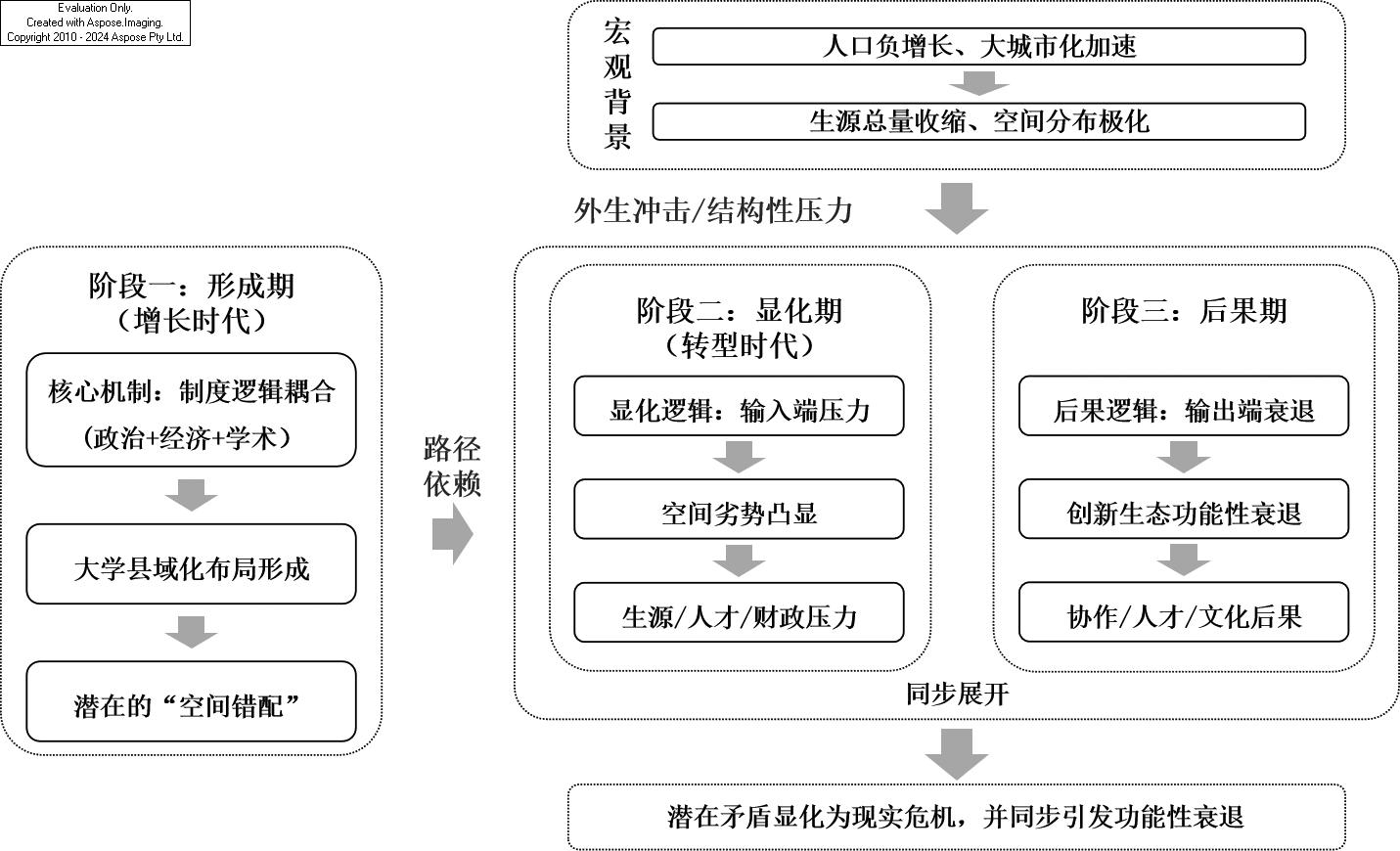
在中国人口负增长与大城市化背景下,大学的“县域化”呈现出显著的空间与结构张力。这一始于增长时代的扩张浪潮,在人口收缩时代不仅没有停止,反而因战略性资源争夺等新动因得以延续。研究借鉴新制度主义、空间生产与区域创新生态系统理论,构建“制度惯性—空间错配—生态失效”三阶段动态模型,解释其背后的生成机制与演化逻辑。该模型揭示:大学县域化是特定时期多重制度逻辑耦合的产物,其空间实践内生地生产出潜在的“空间错配”;随着人口由增长转向负增长,这一潜在矛盾被全面显化,最终可能导致宏观创新生态系统的功能性衰退与微观组织文化的断裂。通过对政策文本、宏观数据及中外典型案例的系统分析,本研究为上述模型提供了经验支撑。结论表明,无论扩张动因如何演变,大学县域化在存量博弈时代都将面临区位硬约束,进而可能加剧中心与边缘的空间分化。研究所构建的理论模型为理解转型社会中制度安排的“时效性”及空间与制度的复杂互动提供了新的分析视角。

关键词: 大学县域化, 人口负增长, 区域创新生态系统, 大城市化

Abstract:

Against the backdrop of China’s negative population growth and megalopolitanization, the “county-level diffusion” of universities exhibits prominent spatial and structural tensions. The wave of university expansion initiated during the demographic growth era has not abated amid population contraction. Instead, it has persisted, driven by new incentives such as competition over strategic resources. Drawing on neo-institutionalism, the production of space theory, and the regional innovation ecosystem theory, this paper constructs a three-stage dynamic model of “institutional inertia - spatial mismatch - ecosystem dysfunction” to interpret the formative mechanisms and evolutionary logic behind this phenomenon. The model reveals that the county-level diffusion of universities arises from the coupling of multiple institutional logics in a specific historical period, and its spatial practices inherently breed latent spatial mismatches. As demographic growth shifts to negative growth, such latent contradictions become fully manifest, potentially triggering functional decline of the macro regional innovation ecosystem and breakdown of micro organizational culture. Systematic analysis of policy documents, macro statistical data, and typical domestic and international cases provides empirical evidence for the proposed model. The findings indicate that regardless of shifts in expansion incentives, the county-level diffusion of universities will face rigid locational constraints in an era of stock competition, which may further exacerbate spatial polarization between central and peripheral regions. The theoretical model developed in this research offers a new analytical perspective for understanding the time-bound nature of institutional arrangements and the intricate interactions between space and institutions in transitional societies.

Key words: county-level diffusion of universities, negative population growth, regional innovation ecosystem, megalopolitanization

中图分类号: