治理研究 ›› 2026, Vol. 42 ›› Issue (1): 64-78.

• 数字治理 • 上一篇    下一篇

迈向均衡结构:数字平台下沉驱动的基层治理结构重塑及其优化

吕俊延, 张小劲   

  • 收稿日期:2025-07-18 出版日期:2026-01-15 发布日期:2026-04-17
  • 作者简介:吕俊延,清华大学“水木学者”,清华大学数字政府与治理研究院助理研究员;
    张小劲,清华大学政治学系长聘教授、博士生导师。
  • 基金资助:
    国家社会科学基金重大项目“政务数据赋能数字政府效能提升的机制与路径研究”(25&ZD217);北京社科重大项目“北京构建超大城市现代化治理体系的理论和实践”(24LLZZA097);中国工程院重点咨询项目“ 智能社会风险国际合作治理研究”(2025XZ10);国家资助博士后研究人员计划项目(GZB20250870)

Toward a Balanced Structure: Reshaping and Optimizing Grassroots Governance through Digital Platform Penetration

Lv Junyan, Zhang Xiaojin   

  • Received:2025-07-18 Published:2026-01-15 Online:2026-04-17

摘要:

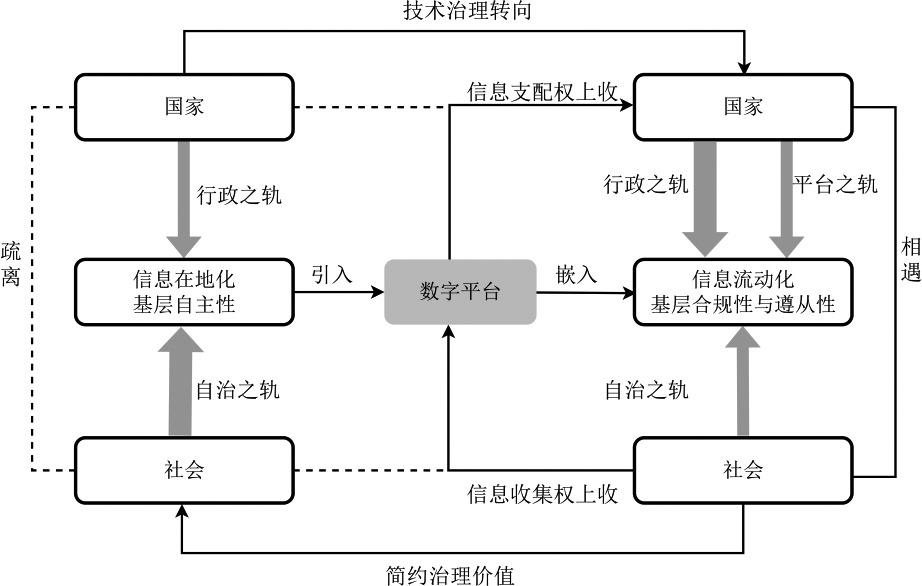
基层治理正经历数字平台驱动的智能化转型,并催生智能社会治理这一全新样态。数字技术为赋能基层治理提供工具支撑,也为基层减负提供技术路径。然而,少有研究追踪技术嵌入后如何影响基层治理权力结构。研究表明,国家通过“信息上收—控制权上移—权力再分配”的过程机制提升自身信息能力,并由此引发基层治理的结构性变革。数字技术在传统基层治理的自治之轨和行政之轨之中,增加了平台之轨,这极大重塑了基层治理权力结构。数字平台在很大程度上可以突破信息的地方性,并通过信息控制权的向上集中,实现信息权力从基层向高层政府转移。由于数字平台的逐级搭建,基层工作者在国家与社会间的中介作用被削弱。在技术的透视下,基层工作者因增加诸多规范化的治理程序而减少自主行动空间,由此形成技术减负困境。数字时代尤其需要发掘简约治理的价值,建设一个简约、高效的数字治理生态体系。

关键词: 国家信息能力, 数字平台, 智能社会治理, 基层减负, 双轨政治

Abstract:

Grassroots governance is undergoing an intelligent transformation driven by digital platforms, giving rise to a new configuration of smart social governance. Digital technologies provide instrumental support for empowering grassroots governance and offer technical pathways for alleviating administrative burdens at the grassroots level. However, few studies systematically examine how the embedding of digital technology reshapes the power structure in grassroots governance. This study shows that the state enhances its information capacity through a process mechanism characterized by upward information aggregation, upward transfer of control, and power redistribution, thereby triggering structural changes in grassroots governance. By introducing a platform-based track into the traditional dual track of autonomy and administration, digital technology profoundly alters the power structure. Digital platforms largely transcend the locality of information and facilitate the transfer of informational power from grassroots government to higher-level governmentby centralizing control over information upward.As digital platforms are constructed and integrated hierarchically, the intermediary role of grassroots workers between the state and society is significantly weakened. Under conditions of technological mediation, grassroots workers are increasingly subject to standardized and proceduralized governance requirements, which constrain their discretionary space for action and giverise to a paradox of technological burden reduction. These findings suggest thatit is essential to reclaim the value of minimalist governance to build a streamlined and efficient digital governance ecosystemin the digital era.

Key words: state information capacity, digital platforms, smart social governance, grassroots burden reduction, dual-track politics

中图分类号: