Governance Studies ›› 2025, Vol. 41 ›› Issue (5): 51-71.
Previous Articles Next Articles
Dong Leiming, Zhang Xulijing
Received:
Online:
Published:
Abstract:
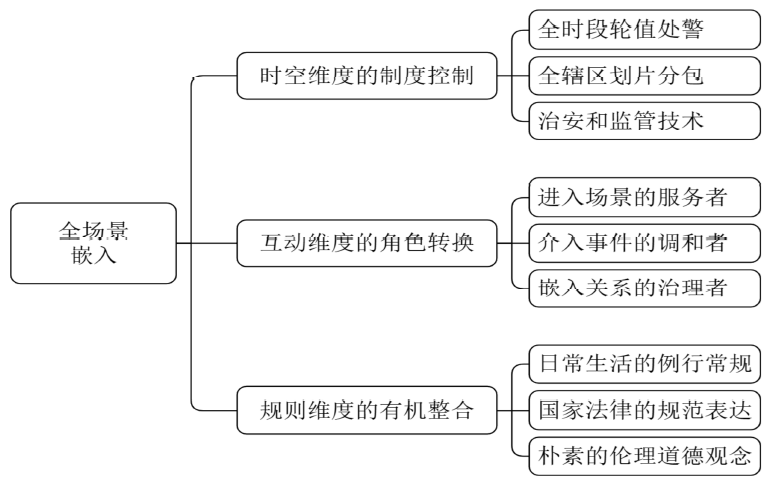
hina is building a Safe China and a Law-Based China. During this process, a comprehensive governance system has formed in its grassroots society. This system is characterized by high integration, embeddedness, and regularity. It reflects the institutional advantages of socialism with Chinese characteristics. Comprehensive governance integrates information, relationships, and regulatory resources from both the Party-government system and local communities. This integration occurs within the framework permitted by law. It enables context-sensitive approaches to complex issues. The actors in such governance often hold pluralistic authority. Through an all-scenario embedded working mechanism, they grasp the routine practices and behavioral logics of local communities. As a result, comprehensive governance overcomes the limitations of professional governance. It bridges the gap between formal institutions and everyday life. It also mitigates the challenges in power-responsibility asymmetries. Ultimately, it achieves the overarching goal of promoting good governance through sound laws and ensuring long-term social stability.
Key words: national governance, grassroots governance, social life disputes, comprehensive governance, police mediation
CLC Number:
D630
Dong Leiming, Zhang Xulijing. Comprehensive Governance: The Practical Logic of Dispute Governance in China[J]. Governance Studies, 2025, 41(5): 51-71.
0 / / Recommend
Add to citation manager EndNote|Ris|BibTeX
URL: http://journal08.magtech.org.cn/Jwk3_zlyj/EN/
http://journal08.magtech.org.cn/Jwk3_zlyj/EN/Y2025/V41/I5/51